Selecting the right drum handling equipment is essential for ensuring workplace safety, efficiency, and productivity. With numerous options available, it can be challenging to determine the best solution for your facility. Here’s a step-by-step guide to help you make an informed decision.
Step 1. Evaluate Your Current Drum Collection
Start by reviewing the specifications of the drums you have at your facility.
- Types of Drums: Are you handling steel, plastic, or fibre drums?
- Drum Sizes: Note the sizes of your drums, such as 210L or 114L.
- Drum Weight: Determine the weight of your heaviest drum.
- Drum Rims: confirm if all drums have a top rim, which is essential for certain types of handlers.
- Drum Contents: Identify the type of contents in your drums, such as liquids, powders, or granules.
Step 2. Define Your Drum Utilisation Needs
Next, consider how you utilise or plan to utilise your drums.
- Move and Transport: Will you need to move upright drums?
- Lift and Pour: How high will the drum need to be raised for pouring?
- Rack Drum: Will you rack drums upright or horizontally? What is the maximum height?
- Mix Drum Contents: Will you require a tumbler for vigorous mixing or a roller for gently mixing?
Step 3. Determine the Type of Drum Handler You Need
Based on your drum collection and utilisation needs, choose the appropriate type of drum handler.
- Forklift Attachment: For lifting drums with a forklift.
- Below-Hook Drum Handler: For Handling drums using a crane or hoist.
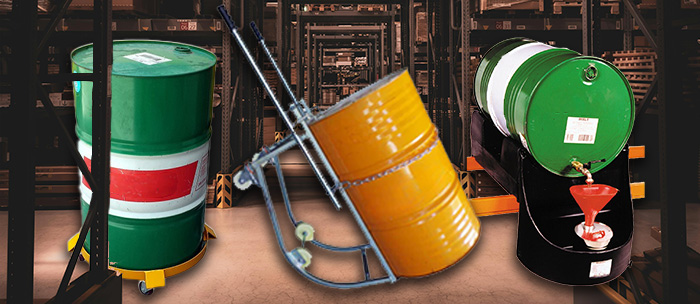
- Mobile Drum Handler: For moving drums around your facility.
- Powered or Manual Drum Handler:
- Battery Powered – Ideal for mobility and ease of use.
- Air Powered – Suitable for environments where air power is preferred.
- Plug-in Electric Powered – Ensure compatibility with your power supply’s phase, voltage, and frequency (Hz).
- Fully Manual – Cost effective for low frequency or lighter tasks.
- Special requirements:
- Stainless Steel Equipment – Necessary for food, pharmaceutical, and chemical industries to ensure hygiene and corrosion resistance.
- Spark Resistant Equipment – Essential for hazardous areas with flammable or explosive materials. Determine the class and group of the hazardous area.
Drum Handling Safety Solutions
Choosing the right drum handling equipment is not just about efficiency; it’s also about ensuring safety. Here are some safety solutions to consider.
Reduce Risks and Safety Concerns – Provide stable and controlled handling of drums.
Avoid Back Strain and Hand Injuries – Use ergonomically designed equipment to minimise physical strain on workers.
Prevent Spills – Ensure secure handling mechanisms to transport drum contents safely.
Ensure Safe Drum Handling in Hazardous Environments – Use specialised equipment for handling drums in areas with flammable or explosive materials.
Eliminate the Need for Bare Fork Drum Handling – Opt for equipment that offers more secure and precise handling compared to using bare forks, reducing the risk of accidents.
By following these steps and considering safety solutions, you can identify the precise drum handling equipment that meets your operational needs while ensuring safety and efficiency. For more information on choosing the right drum handling equipment, or to find the perfect solution for your application, contact our team of experts today.