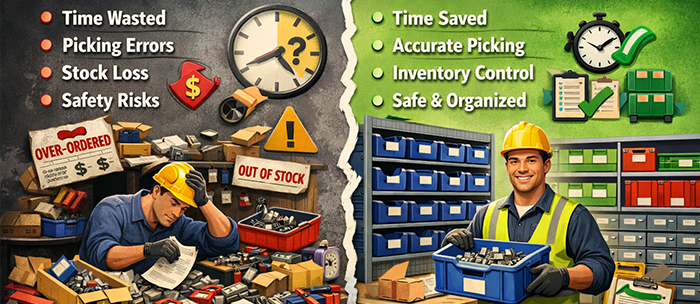
How much time does your team waste searching for small parts each day?
In many workshops, warehouses, and manufacturing facilities, the answer is more than anyone realises. Poorly organised storage doesn’t just create clutter—it slows production, increases costs, and makes everyday tasks harder than they need to be.
From misplaced fasteners and fittings to duplicate orders and picking errors, inefficient small parts storage quietly impacts productivity across an entire operation. The good news? A few simple improvements can deliver significant gains in efficiency, safety, and stock control.
1. Every Minute Spent Searching Costs Money
Disorganised storage leads to repeated searching, double-handling, and constant interruptions that slow work down for more than most teams realise. Even losing just a few minutes on each task can add up to hours of wasted time across a team over the course of a day or week. For maintenance crews, production teams, and warehouse staff who rely on quick access to parts, that delay can disrupt schedules, create frustration, and reduce overall efficiency. Time spent searching for items is time taken away from the work that keeps operations moving.
Imagine a maintenance technician needing four M8 bolts for an urgent repair. Instead of locating them immediately, they spend ten minutes searching through mixed containers before discovering they’re out of stock. That single delay affects maintenance, production, and everyone waiting on the repair.
2. Small Picking Errors Become Big Productivity Problems
Inadequate organisation increases the chance of selecting the wrong size, type, or quantity of parts, especially in fast-paced workshop, warehouse, and manufacturing environments. These mistakes can delay production, create rework, or lead to incorrect repairs that take even more time and resources to fix. Unclear storage systems also make it harder to maintain accountability and accurate stock control, which can quickly affect day-to-day operations. Over time, messy storage frustrates teams, slows workflows, and makes simple tasks far more complicated than they need to be.
3. Poor Visibility Leads to Unnecessary Spending
Substandard visibility makes it hard to know what is actually in stock, which can quickly lead to duplicate orders, excess inventory, and urgent last-minute purchases. Over time, this creates unnecessary spending and leaves businesses with dead stock sitting unused on the shelf, tying up cash that could be better invested elsewhere. Better storage helps reduce waste, improve accuracy, and support tighter stock management, making it easier to keep inventory under control and making buying decisions more efficient.
4. Safety workplace presentation issues
Cluttered or unstable small parts storage can create trip hazards, messy work areas, and unsafe conditions that put staff and operations at risk. Disorganisation also makes it harder to maintain clean, professional, and efficient workspaces, especially where items need to be easy to see, access, and return. In manufacturing, workshop, and engineering environments, poor storage can undermine workflow discipline and make audit readiness more difficult to maintain. A tidy storage system supports both safety and professionalism, helping teams work with greater confidence and consistency.
5. How better storage solves the problem
Better storage creates consistency. Every item has a dedicated location, every compartment is clearly identified, and every employee knows where components belong. Colour coding, labelled bins, modular storage systems, and deeper parts trays reduce search times, improve stock visibility, and simplify replenishment. The result is a workplace that’s easier to manage and more productive every day.
Purpose-built solutions, like DURABIN® parts trays, clearly labelled layouts, and colour-coded schemes, create instant visual cues that cut search times and errors. When storage is standardised, every part has a consistent home and format, making items easier to find, count, and restock without guesswork. Usability jumps with deeper trays that hold bulkier items, compartmentalised systems that prevent mixing, and label-ready fronts that keep identification clear at a glance. For a demanding workplace. Australian-made, industrial-grade storage adds the long-term durability and toughness needed to withstand heavy use, protecting both productivity and your investment.
Small Change, Big Returns
Deficient small parts storage may look like a small inconvenience, but it creates hidden inefficiencies across your entire operation. Misplaced fasteners, overflowing parts trays, and disorganised shelving don’t just slow workers down; they quietly undermine manufacturing efficiency, increase labour costs, and introduce avoidable safety risks. In busy industrial environments, these daily disruptions compound into significant productivity losses.
The advantage is that upgrading your industrial storage solutions doesn’t require a major investment. Simple improvements, better storage, clearly labelled bins, modular storage, and smarter workshop organisation can transform how efficiently teams work. Even small enhancements to warehouse storage layouts or parts handling systems can deliver measurable gains in accuracy, safety, and overall industrial workspace organisation.
Review your current parts storage system, identify the gaps, and make targeted improvements that will pay off.
The image, graphics and information used in this article has been generated using Ai.