Most industrial workplaces and warehouses think of cabinets as boxes for locking things away. Industrial designers see them as machines for moving work faster, safer, and more profitably. The difference is not the steel or the doors, it’s the way cabinet interiors are planned around people, tasks, and flow. When you borrow a few principles from industrial design, the same footprint of storage can suddenly feel bigger, smarter, and far easier to use.
Below are key ideas that industrial designers apply to cabinet layouts that many warehouses overlook, and how you can utilise them for heavy-duty storage.
Design Starts with Tasks, Not Shelves
Industrial designers start by mapping what people actually do, not what a catalogue offers. They look at…
- Which tools or parts are used every hour, every day, and every week?
- Who uses them and in what sequence?
- Where people stand, turn, and walk to complete a job?
In a warehouse, that means planning cabinet interiors around workflows like “receiving and inspection”, “maintenance and repair”, or “order picking”, instead of vague categories like “tools” or “spares”. Frequently used items are placed at hand height, while occasional items are moved to higher or lower levels, and rarely used items are stored in secondary cabinets. The result is a few steps, less bending and reaching, and much less time wasted hunting.
Ergonomics is Intentional, Not Accidental
Most cabinet layouts evolve organically, as new items get squeezed into any available space. Industrial designers are deliberate about ergonomics…
- Most cabinet layouts evolve organically, as new items get squeezed into any available space. Industrial designers are deliberate about ergonomics…
- Heavy items live in the low-to-mid zone, roughly knee to chest height, to avoid lifting above shoulder level.
- Everyday items sit between the shoulder and mid-thigh so they can be grabbed in one motion, without stretching or crouching.
- Only light, infrequently used items are stored up high.
For a warehouse, this might mean shifting your heaviest power tools, jigs, and fixtures off top shelves into mid-level pull-out shelves, and reserving bottom shelves for medium-weight bins that slide out, not awkward boxes you must drag. Done well, you reduce fatigue and the macrostrains that turn into injuries and downtime.
Cabinets Are Part of a Bigger “Zone”
Industrial designers think in zones: preparation, assembly, inspection, packing, etc. Inside each zone, the cabinet layout supports the specific tasks happening in that area.
Translating that idea…
- In a maintenance bay, the cabinet closest to the workbench should hold the tools and consumables used for 80-90% of jobs – hand tools, fasteners, lubricants, common spares, etc.
- In a dispatch zone, cabinets near the packing bench should contain tapes, labels, dunnage, knives, scanners, and printer supplies, not random leftovers.
When each cabinet is assigned to a specific zone and role, staff move less, handoffs become smoother, and new team members can understand the logic of the layout quickly.
Every Compartment Has a Clear Purpose
Industrial designers rarely leave shelves as empty rectangles. They break interiors into purposeful compartments…
- Adjustable shelves to accommodate different carton heights.
- Vertical dividers for files, panels, or jigs so they do not slump and tangle.
- Small parts trays or bins with labels for consumables.
- Hooks, rails, and holders mounted on doors for slim tools and accessories.
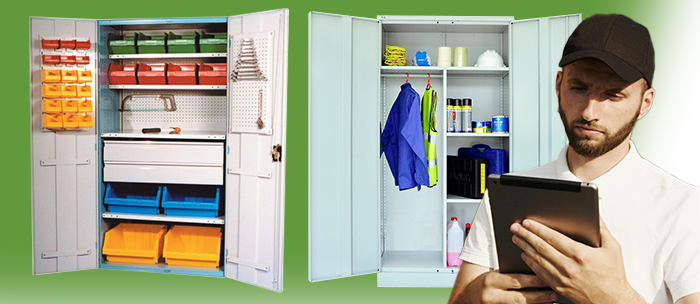
In an industrial cabinet, this might look like one section dedicated to power tools in foam cutouts, another to fasteners in labelled bins, and a third to manuals and lockout-tagout gear stored vertically in a clear folder. Instead of “somewhere in that cabinet”, every item has an obvious, labelled location.
Labelling And Visual Cues Do the Talking
Where many warehouses stop at a label on the door, industrial designers incorporate visual management throughout the cabinet…
- Large, clear labels on each shelf, bin, and divider.
- Colour coding by function (e.g., red for safety gear, blue for maintenance tools, green for consumables).
- Outlines or shadow boards on inner doors so missing items are instantly obvious.
This turns cabinets into self-explanatory systems. Staff do not need the inside knowledge to find things, and supervisors can see at a glance whether a cabinet is complete, replenished, and ready for the next shift.
Flexibility is Built In From Day One
Industrial environments change constantly, new SKUs, new tools, new processes etc. Designers expect this and build flexibility into the cabinet layout…
- Using adjustable shelving and movable dividers.
- Choosing cabinet widths and depths that can accept standard bins and trays, you can reconfigure as needs evolve.
- Leaving a small percentage of space deliberately unallocated to new items can be integrated without a full redesign.
For a warehouse, that means avoiding over-customising interiors around one product set. Instead, you choose a layout that you can re-balance seasonally, like reconfiguring a cabinet from “project specific” storage to “spares and PPE” without buying new furniture.
Data, Not Guesswork, Guides Improvements
Finally, industrial designers watch how people interact with storage, listen to complaints, and refine layout over time based on real use…
- Which doors are opened the most?
- Where are queues or bottlenecks forming?
- Which items are frequently misplaced or “borrowed”?
Warehouse leaders can apply the same thinking by running simple audits: how long it takes to find critical tools, record common pick errors, and track which cabinets generate the most questions. Small layout tweaks, moving a few high-use items to eye level, adding labels, or reshuffling zones, can yield outsized gains.
Turning Industrial Design Insight Into Warehouse Advantage
You do not need a designer on staff to use these principles. A practical starting checklist for your heavy-duty cabinets could be…
- Identify your top 20 most-used items in each zone and move them to prime, mid-height positions.
- Reorganise one key cabinet so everything is visible and reachable within two actions.
- Add clear labelling and simple colour coding to one bank of cabinets.
- Schedule a quarterly “cabinet review” to adjust layouts as workflows change.
By treating cabinet layout as a strategic design problem, rather than a storage afterthought, you can unlock faster workflows, safer handling, and a more professional-looking warehouse. Industrial designers have understood these benefits for years, and most facilities are only just beginning to tap into them.
Contact the team at Krosstech to help find the right cabinet to help fulfil your storage requirements.